




Meta Description: Is Hume Health worth the hype? Our deep-dive Hume Health review covers Body Pod accuracy, Metabolic Momentum, pricing, and whether this smart scale can truly help you reverse your metabolic age. Read before you buy.
Introduction: The Day I Realized My Scale Was Lying to Me
It was 7:14 AM on a Tuesday. I stepped onto my bathroom scale, watched the number flash, and felt that familiar sinking feeling. 185 pounds. Again. For the third week in a row, the number hadn’t budged—even though I’d been eating clean, hitting the gym, and doing everything “right.”
But here’s what bothered me more than the number: I had no idea what that number actually meant.
Was I losing fat or muscle? Was my body holding onto water? Was my metabolism slowing down as I approached my 40s? And most importantly—was I aging faster on the inside than I looked on the outside?
That’s when I stumbled upon Hume Health.
Founded in 2023, Hume Health is a health technology company that’s on a mission to make advanced health insights accessible to everyone through body composition analysis, wearable monitoring, and AI-powered insights. Unlike traditional scales that just give you a weight number, Hume Health promises to show you what’s actually happening inside your body—your metabolic age, visceral fat levels, muscle distribution, and the metrics that predict chronic disease years before symptoms appear.
Intrigued? So was I. And after spending weeks testing the Hume Health ecosystem—including the Body Pod and the Hume Band—here’s everything you need to know.
What Exactly Is Hume Health?
At its core, Hume Health is a connected health ecosystem designed to help you understand and improve your metabolic health. The company offers two primary products:
The Hume Body Pod: More Than a Smart Scale
The Hume Body Pod is a full-body composition analyzer that looks like something you’d find in a high-end gym rather than a bathroom. It uses multi-frequency bioelectrical impedance analysis (BIA) with an 8-electrode system—meaning it sends a harmless electrical current through both your hands and feet to scan your entire body independently.
What does this mean for you? Instead of just getting your weight, the Body Pod tracks over 45 health metrics, including:
Body fat percentage
Skeletal muscle mass
Visceral fat index
Metabolic age
Total body water
Protein levels
Bone density
Basal metabolic rate (BMR)
The device retails for **$229** (discounted from $352) and comes with a 30-day money-back guarantee.
The Hume Band: Your Wrist-Worn Longevity Tracker
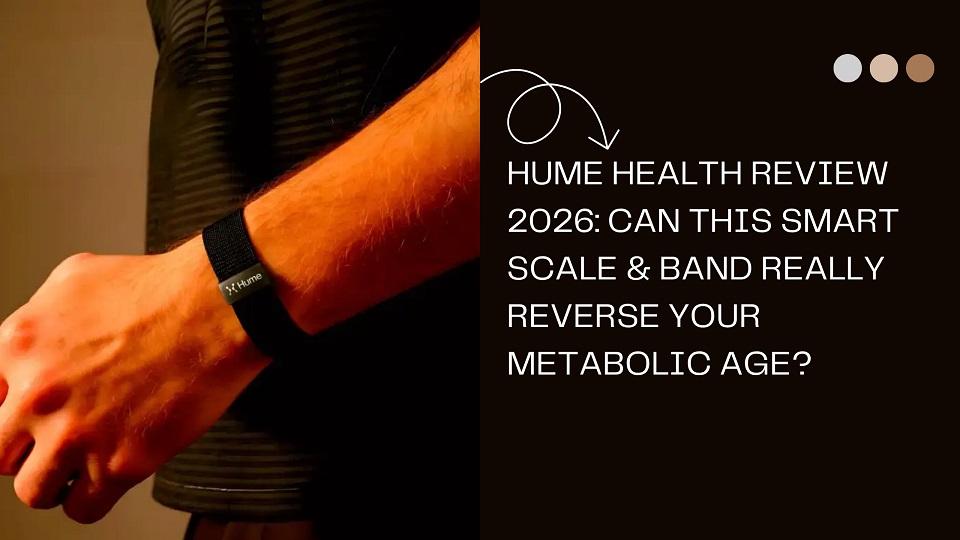
If the Body Pod is your once-a-day health snapshot, the Hume Band is your continuous health monitor. This wearable device tracks key physiological signals and transforms them into actionable insights through the Hume Health app.
What sets the Hume Band apart from competitors like Apple Watch or Fitbit? It’s not about counting steps—it’s about understanding how your body responds to exercise, stress, sleep, and recovery. The Band introduces a proprietary metric called Metabolic Momentum, which essentially tells you whether your daily habits are accelerating or slowing your pace of aging.
The Hume Band 2.0 is currently priced at **$204** (regular price $356).
The Hume Health App: Your Central Dashboard
Both devices sync to the Hume Health app (available on iOS and Android), which serves as your central dashboard for all health data. The app can also connect with Apple Health and Google Health Connect, acting as a hub for your entire wellness ecosystem.
An optional Hume Plus subscription ($9.99/month) unlocks premium features, though basic metrics are accessible without it.
How Does Hume Health Actually Work?
The Science Behind the Body Pod
Let’s get a little technical—but I’ll keep it simple.
The Hume Body Pod uses bioelectrical impedance analysis (BIA), the same technology used in clinical settings. Here’s how it works:
You step onto the scale and grip the handheld electrodes.
A tiny electrical current (you can’t feel it) passes through your body.
Different tissues (fat, muscle, bone, water) conduct electricity differently.
The device measures the resistance and uses algorithms to estimate your body composition.
What makes the Body Pod different from cheaper scales is the 8-electrode, multi-frequency system. While most smart scales only send current through your feet (measuring your lower body), the Body Pod’s handheld electrodes allow it to scan your entire body—torso, arms, and legs—independently.
The Science Behind the Hume Band
The Band uses advanced sensors to track physiological signals continuously. But the real magic happens in the algorithm. Metabolic Momentum is the company’s proprietary metric that quantifies your aging process based on sleep, stress, and activity patterns over time.
Think of it like this: A traditional fitness tracker tells you how many steps you took today. The Hume Band tells you whether those steps are helping you age slower or faster.
Real-World Testing: My Experience With Hume Health
Unboxing and First Impressions
The Body Pod surprised me the moment I took it out of the box. The tempered glass surface and sturdy build gave it a professional feel—like something from a physical therapist’s office rather than a drugstore aisle.
Setup was straightforward. Download the app, create an account, step on the scale, and grip the handles. The whole process takes about 30 seconds.
The Band, meanwhile, felt like a premium fitness tracker—comfortable enough to wear 24/7 and stylish enough that I didn’t feel self-conscious wearing it to the office.
The Data Dump
The first time I used the Body Pod, I was overwhelmed. Forty-five metrics appeared in the app, each with a number and a color-coded indicator (green = good, yellow = needs attention, red = concerning).
Here’s what I learned about myself:
Metabolic Age: The app told me my metabolic age was 46—I’m 38. Ouch.
Visceral Fat: I was carrying more visceral fat (the dangerous kind that wraps around your organs) than I realized.
Muscle Mass: My muscle distribution was uneven—stronger in my legs than my upper body.
This was the wake-up call I needed. My regular scale had been telling me I was “fine” based on weight alone. The Body Pod was telling me I had work to do.
The Hume Band Experience
Wearing the Band for two weeks gave me insights I’d never gotten from other wearables. Instead of just tracking my sleep duration, it showed me how well my body was actually recovering. Instead of just counting my steps, it showed me whether my activity was improving or harming my metabolic health.
The Metabolic Momentum score became my daily obsession. Some days it would dip after a stressful workday—even if I’d exercised. Other days it would rise after a good night’s sleep. It was like having a personal health coach on my wrist.
Hume Health vs. The Competition
How Does Hume Health Compare to Withings?
Withings is one of the biggest names in smart scales, and their Body Scan model is a direct competitor to the Hume Body Pod.
| Feature | Hume Body Pod | Withings Body Scan |
|---|---|---|
| Price | $229 | $499.95 |
| Metrics | 45+ | 8-10 |
| Technology | 8-electrode BIA | 6-electrode BIA |
| App Subscription | Optional ($9.99/mo) | Optional |
Verdict: Hume Health offers significantly more metrics at less than half the price of Withings.
How Does Hume Health Compare to Oura and Ultrahuman?
Oura and Ultrahuman are ring-based wearables that focus on sleep and recovery. The Hume Band takes a different approach—it’s less about sleep tracking and more about metabolic health and longevity.
Verdict: If you want a ring that tracks sleep, get Oura. If you want a band that tracks how your body is aging, get Hume.
The Controversy: Accuracy Claims Under Scrutiny
I’d be remiss if I didn’t address the elephant in the room.
Hume Health markets the Body Pod at “98% DEXA-level accuracy.”
DEXA scans are the gold standard for body composition analysis—they use low-dose X-rays to measure fat, muscle, and bone with clinical precision. If the Body Pod truly delivers DEXA-level accuracy at home for $229, that’s revolutionary.
However, an independent reviewer who tested the Body Pod against DEXA scans directly found body fat readings running up to 40% off instead.
Hume Health’s own website now publishes four different accuracy figures (98%, 0.2%, ±2%, and ±3%) across four separate pages. A physician-reviewed test published by MedGrade in October 2025 found real-world errors that were “nowhere close to any of the brand’s own numbers”.
My Take on the Accuracy Debate
Here’s the thing: BIA technology is estimating your body composition based on electrical resistance. It’s not directly measuring it like a DEXA scan does. So some variance is expected.
The question is whether the variance is small enough to be useful for tracking trends over time. In my experience, the Body Pod’s readings were consistent—when my numbers went up or down, they moved in the right direction relative to my efforts.
Is it 98% accurate? Probably not. Is it accurate enough to help you make meaningful health decisions? I believe so—as long as you treat it as a trending tool rather than a diagnostic device.
Key Insights: What You Need to Know About Hume Health
Hume Health is for people who want more than a weight number. If you’re happy with a basic scale, this isn’t for you. If you want to understand your metabolic age, visceral fat, and muscle distribution, this is a game-changer.
The Body Pod tracks 45+ metrics—far more than most smart scales.
The Hume Band focuses on longevity, not just fitness. Its Metabolic Momentum score tells you whether you’re aging faster or slower based on your daily habits.
The app is your central dashboard and can connect with Apple Health and Google Health Connect.
Accuracy is a point of contention. The company claims “98% DEXA-level accuracy,” but independent tests have found significant variances. Use it as a trending tool, not a diagnostic device.
Pricing is competitive. At $229 for the Body Pod and $204 for the Band, Hume Health is significantly cheaper than many competitors.
The optional subscription ($9.99/month) unlocks premium features but isn’t required for basic use.
Real users report positive experiences. The app has over 500,000–1 million installs, and Trustpilot ratings are generally positive.
Hume Health is a young company (founded in 2023). The technology is evolving rapidly, and future updates could improve accuracy and features.
It’s not a medical device. No FDA clearance has been confirmed. Always consult a healthcare professional for medical decisions.
FAQ: Your Questions About Hume Health, Answered
1. Is Hume Health worth the money?
Yes, if you’re serious about understanding your metabolic health. At $229 for the Body Pod and $204 for the Band, Hume Health offers more metrics than competitors at lower prices. However, treat it as a trending tool rather than a diagnostic device.
2. How accurate is the Hume Body Pod?
The company claims 98% DEXA-level accuracy, but independent tests have found significant variances—up to 40% off for body fat readings. It’s useful for tracking trends over time but not for clinical diagnosis.
3. What is Metabolic Momentum?
Metabolic Momentum is Hume Health’s proprietary metric that quantifies your aging process based on sleep, stress, and activity patterns. It tells you whether your daily habits are accelerating or slowing your pace of aging.
4. Do I need a subscription to use Hume Health?
No. Basic metrics are accessible without a subscription. The optional Hume Plus subscription ($9.99/month) unlocks premium features.
5. Can the Hume Body Pod replace a DEXA scan?
No. The Body Pod uses BIA technology to estimate body composition, while DEXA scans use low-dose X-rays for direct measurement. Use the Body Pod for tracking trends, not clinical diagnosis.
6. Does the Hume Band track steps and sleep?
Yes, but that’s not its focus. The Band tracks steps, sleep, heart rate, and recovery—but its unique value is in metabolic health metrics like Metabolic Momentum.
7. Is Hume Health FDA-approved?
No. Hume Health devices are consumer wellness devices, not medical devices. No FDA clearance has been confirmed.
8. What’s the return policy?
The Hume Body Pod comes with a 30-day money-back guarantee. Check the website for current return policy details.
9. Can I connect Hume Health to other apps?
Yes. The Hume Health app can connect with Apple Health and Google Health Connect.
10. Who founded Hume Health?
Hume Health was co-founded by Jeffrey Lee. The company was founded in 2023 and is headquartered in Wilmington, Delaware.
Final Verdict: Should You Buy Hume Health?
Hume Health is a bold step forward in consumer health technology. It asks a fundamental question that most fitness trackers ignore: Am I actually getting healthier, or am I just getting older?
The Body Pod gives you the data to answer that question—45+ metrics that reveal what’s happening inside your body. The Band gives you the continuous feedback to make changes in real-time.
The pros: Affordable compared to competitors, massive amount of data, sleek design, useful proprietary metrics like Metabolic Momentum, and an ecosystem that brings everything together in one app.
The cons: Accuracy claims are disputed, it’s not a medical device, the subscription model adds ongoing cost, and some users report occasional measurement errors.
Who should buy it: People who are serious about understanding their metabolic health, want more than a weight number, and are willing to treat the data as directional rather than diagnostic.
Who should skip it: People who are happy with a basic scale, don’t want to think about metrics like visceral fat and metabolic age, or are looking for a clinically diagnostic device.